MEDA: Measurement-Efficient Majorana Zero Mode Detection
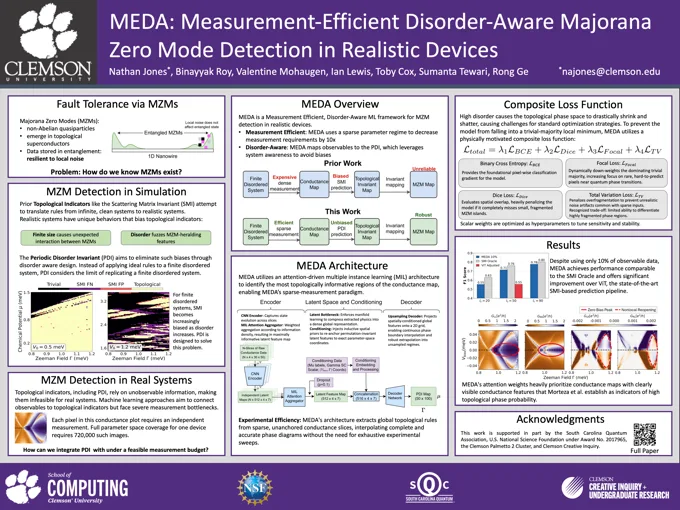
End-to-end deep learning pipeline for predicting Majorana zero mode phase diagrams from semiconductor-superconductor nanowire conductance data. Trains a modified ResNet-18 CNN autoencoder on up to 900 million synthetic Kwant-generated conductance measurements spanning a 6-dimensional parameter space with realistic disorder profiles. Features Monte Carlo dropout uncertainty quantification and supports transfer to experimental measurements.
Identifying Majorana zero modes (MZMs) in nanowire experiments remains challenging due to the similarity between topological signatures and disorder-induced trivial states. This project applies convolutional neural networks to automate the classification of MZM visibility from simulated conductance data G(V_bias, V_gate), bridging the gap between theoretical predictions and experimental observables.
Data generation uses Kwant-based quantum transport simulations on a 6-dimensional parameter grid (disorder strength, Zeeman field, chemical potential, superconducting gap, bias voltage, and spin-orbit coupling), producing 300–900 million conductance measurements across three disorder correlation lengths. Each sample is labeled with topological invariants: the winding number and a periodic disorder invariant (PDI) for robust phase detection beyond simple gap-based criteria.
The CNN architecture extends ResNet-18 with a 4-channel encoder, label embedding decoder, CoordConv layers, and gated attention multiple-instance learning (MIL) pooling. Training uses a composite loss function combining binary cross-entropy, Dice, focal, and total variation terms, optimized with AdamW and cosine annealing warm restarts. Disorder-based train/val/test splitting (80/10/10) prevents data leakage by ensuring no disorder profile appears in multiple splits.
Inference supports single-slice and multi-slice modes with Monte Carlo dropout uncertainty quantification. Evaluation metrics include Hausdorff distance, Dice/IoU coefficients, boundary-aware F1, and μ-informativeness analysis identifying the most diagnostic parameter slices. Bootstrap confidence intervals quantify statistical uncertainty across disorder realizations.
The pipeline runs on Clemson’s Palmetto HPC cluster with A100 GPUs, using mixed-precision training (torch.amp) and torch.compile for performance. HDF5 chunked storage handles the large datasets, and the system supports experimental data input (CSV/HDF5/npy) for transfer to real measurements.
Key tools: PyTorch 2.x, Kwant, NumPy, SciPy, h5py, Matplotlib, SLURM/HPC